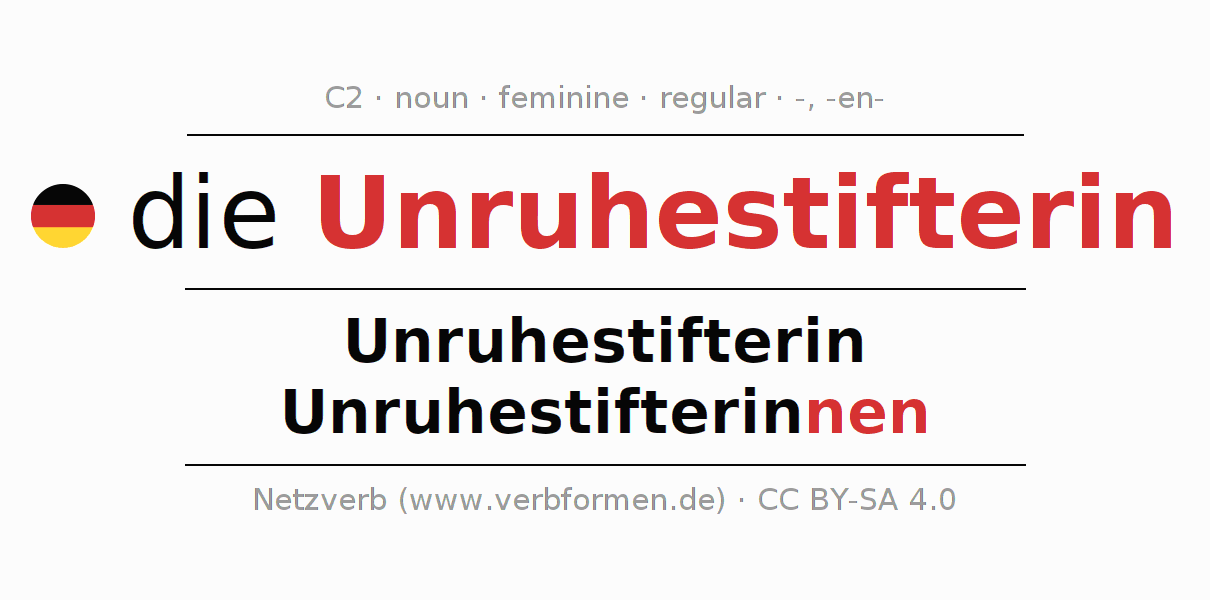
Unruhestifterin Explained: From Troublemaker to Innovator
In the rich tapestry of the German language, certain words capture a nuanced essence that defies simple translation. Unruhestifterin is one such term, a compound noun that literally translates to "peace disturber" or "troublemaker." However, its meaning stretches far beyond this initial interpretation, encompassing a fascinating dual nature that can be both destructive and profoundly constructive. While often carrying a derogatory connotation, referring to a female person (or institution/concept with feminine grammatical gender) who causes discord, the term also surprisingly extends to describe a catalyst for intellectual curiosity, innovation, and positive societal change.
This article delves into the multifaceted world of the Unruhestifterin, exploring her traditional portrayal as a disruptive force and her evolving identity as an essential driver of progress. We'll uncover how a single word can encapsulate roles as diverse as a neighborhood nuisance and a philosophical trailblazer, highlighting the critical distinction between chaos for its own sake and friction that sparks transformation.
The Traditional View: Unruhestifterin as a Disturber of Peace
At its core, the most common understanding of Unruhestifterin leans towards the negative. It paints a picture of someone who actively disrupts harmony, causes annoyance, or incites conflict. This interpretation aligns with synonyms like "Krawallmacherin" (rowdy maker), "Randaliererin" (hooligan/rioter), or "Ruhestörerin" (peace disturber). The references provide vivid examples of this archetype:
- Individual Disruptions: Imagine a resident creating a disturbance, shouting and kicking doors, leading to police intervention, or unruly passengers on an airplane whose alcohol-fueled behavior forces an emergency landing. These are clear instances of an Unruhestifterin causing immediate, tangible disruption to peace and order. Their actions often stem from personal issues, lack of self-control, or disregard for communal norms, resulting in discomfort, fear, or even danger for those around them.
- Political and Geopolitical Agitators: Beyond individual acts, the term can also describe entities causing broader instability. Historically, a political party like the CSU might have been labeled a "notorische Unruhestifterin" within a government coalition, constantly challenging the status quo or creating internal friction. Similarly, a nation like Turkey might be perceived as a "grössere Unruhestifterin" on the global stage, challenging established alliances or norms and thereby creating geopolitical tension. In these contexts, the disruption might be strategic, aimed at gaining leverage or asserting influence, but it still fits the mold of disturbing a prevailing sense of calm or consensus.
In these scenarios, the Unruhestifterin is perceived as a problem, an obstacle to smooth functioning, and someone whose actions elicit negative reactions ranging from frustration to condemnation. Society inherently values order and predictability, making those who intentionally or unintentionally upset this balance often viewed with apprehension or disdain. Their immediate impact is usually negative, requiring intervention to restore equilibrium.
Beyond the Negative: Unruhestifterin as a Catalyst for Change
What makes Unruhestifterin truly fascinating is its capacity to transcend the purely pejorative. The word also encapsulates a more enlightened role: that of an individual or entity that stimulates critical thought, encourages discussion, and provokes necessary activity. Here, the "unrest" is not about chaos, but about challenging complacency and igniting progress. This is where the concept truly shifts from a troublemaker to an innovator.
- Intellectual and Philosophical Provocateurs: Philosophy itself is hailed as a "heilsame Unruhestifterin" (a beneficial troublemaker). It possesses the unique quality of endlessly questioning and doubting what is commonly held as definitive and unassailable. This intellectual friction is vital for expanding knowledge and fostering deeper understanding. Similarly, intellectual literature can be an Unruhestifterin, acting as a "Störfaktor" (disrupting factor) that forces readers to confront uncomfortable truths or rethink ingrained beliefs.
- Sporting Innovators: In sports, an Unruhestifterin can be a highly strategic player who disrupts the opponent's defense, creating openings and opportunities. Examples include footballers like Salma Paralluelo or Lena Petermann, whose dynamic play and ability to challenge defensive lines make them invaluable assets. Their "disruption" is precisely what their team needs to score and win, transforming potential chaos into productive strategy.
- Cultural and Artistic Rebels: The punk movement in Weimar in the 1980s, with its resistant, shrill sound and DIY ethos, epitomized youthful Unruhestifterinnen. They challenged socialist norms, not just for the sake of it, but to express dissent and forge a new cultural identity. Fashion, too, can be a "sympathischste Unruhestifterin aller Zeiten" (the most likeable troublemaker of all time), constantly pushing boundaries, questioning aesthetics, and driving evolving trends. These are instances where "trouble" leads to artistic expression, social commentary, and cultural evolution.
In this light, the Unruhestifterin becomes a vital force. She challenges the status quo, exposes shortcomings, and dares to imagine alternatives. Her actions might initially create discomfort, but they are often a precursor to innovation, growth, and meaningful transformation. This kind of disruption is not about destruction but about creative reconstruction.
Navigating the Spectrum: When is Disruption Productive?
The duality of Unruhestifterin begs the question: how do we distinguish between destructive troublemaking and productive provocation? The line is often thin, and the perception can be highly subjective, depending on one's perspective, values, and the immediate context. However, several factors can help us navigate this complex spectrum:
- Intent: Is the disruption driven by malice, selfishness, or a disregard for others? Or is it fueled by a genuine desire for improvement, justice, or innovation? A true constructive Unruhestifterin typically has a vision for a better future, even if her methods are unconventional.
- Impact: Does the disruption lead to lasting damage, irreversible chaos, or a breakdown of essential systems? Or does it, after an initial period of adjustment, result in improved conditions, new opportunities, or clearer understanding? Productive disruption might cause temporary discomfort but ultimately fosters progress.
- Context: A stable, well-functioning system might not need an Unruhestifterin, and her actions might genuinely be disruptive. However, in stagnant, unjust, or complacent environments, an Unruhestifterin can be precisely what is needed to shake things up and initiate overdue change.
- Solutions Offered: A destructive troublemaker merely points out problems or creates them. A constructive Unruhestifterin, while challenging existing norms, often brings new ideas, alternative perspectives, or even actionable solutions to the table, paving the way for a better path forward.
Understanding this distinction is crucial for leaders, innovators, and even individuals seeking personal growth. Embracing the spirit of the constructive Unruhestifterin means cultivating the courage to challenge assumptions, question authority, and advocate for different approaches, always with an eye towards positive outcomes. For a deeper dive into this fascinating interplay, explore Unruhestifterin: The Dual Role of Disruptor and Catalyst.
Unruhestifterin in Modern Contexts: Society, Culture, and Innovation
The concept of the Unruhestifterin resonates powerfully in today's rapidly evolving world, transcending its specific German linguistic origin to represent a universal archetype. In an era defined by constant change and the need for fresh perspectives, the role of the constructive disruptor has never been more vital. We see the spirit of the Unruhestifterin manifesting in various modern contexts:
- Technological Innovation: Startups that challenge established industries (think ride-sharing apps disrupting traditional taxis, or streaming services upending cable television) are prime examples of institutional Unruhestifterinnen. Their "disruption" might cause initial upheaval for legacy businesses, but it ultimately drives progress, improves consumer experience, and often creates entirely new markets.
- Social Justice Movements: Advocates and activists who challenge systemic inequalities and demand change are true social Unruhestifterinnen. They disrupt comfort, provoke difficult conversations, and push for legislative and cultural shifts. While their actions might be met with resistance, they are essential for dismantling prejudice and building a more equitable society.
- Art and Media: Artists who push boundaries, filmmakers who tackle controversial subjects, or journalists who expose uncomfortable truths embody the artistic Unruhestifterin. They challenge audience expectations, spark debate, and hold a mirror up to society, prompting introspection and dialogue.
- Organizational Leadership: Within companies, leaders who encourage a culture of questioning, innovation, and "good trouble" are cultivating an internal Unruhestifterin mindset. They understand that complacency is the enemy of progress and that strategic disruption can lead to competitive advantage and sustainable growth.
Recognizing the positive potential of the Unruhestifterin encourages us to re-evaluate our knee-jerk reactions to disruption. Not all challenges to the norm are threats; many are opportunities in disguise. It prompts us to ask: Is this challenge a symptom of chaos, or a signpost towards necessary evolution? To delve deeper into the broader implications, consider reading Understanding Unruhestifterin: Its Impact in Politics and Culture.
Conclusion
The word Unruhestifterin offers a fascinating lens through which to view the dynamics of change and stability. Far from being a simple pejorative, it embodies a complex spectrum ranging from outright troublemaker to indispensable innovator. While some Unruhestifterinnen undoubtedly bring chaos and harm, others are the very catalysts our societies, cultures, and industries need to evolve, grow, and improve. By understanding the nuances of intent, impact, and context, we can learn to appreciate the "good trouble" that sparks progress and thoughtfully address the "bad trouble" that causes only discord. Embracing the positive spirit of the Unruhestifterin means fostering an environment where critical thinking, challenging norms, and provoking meaningful discussions are not just tolerated, but actively encouraged for a vibrant and progressive future.